Acute Stroke Thrombectomies are established but scarcely available. They are also a costly affair. Nevertheless, the benefits far outweigh the costs and should be actively advised in LVOs to prevent mortality and morbidity. The benefits in properly selected patients may be extended to a 24-hour window or even beyond.
Posts
Vertebral Spine Biopsy
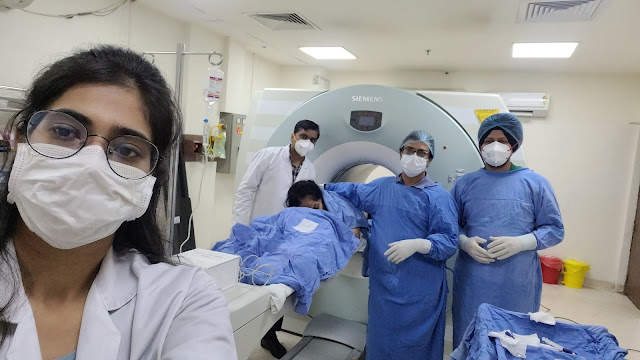
A definitive tissue diagnosis of a vertebral lesion can be made with a minimally invasive, safe, and accurate method called CT-guided percutaneous vertebral biopsy . The most effective substitute for a surgical biopsy is frequently a CT-guided vertebral biopsy. The identification of spinal lesions is mostly dependent on magnetic resonance imaging (MRI). Even while recent advances in MRI now make it possible to recognize and suspect the nature of vertebral lesions and positron emission tomography-computed tomography (PET-CT) provides data on lesion metabolism, a biopsy is still required in the majority of instances. Both open surgery and a less invasive (percutaneous imaging-guided) procedure can be used to confirm the histopathology of a vertebral lesion. An open surgical biopsy of a vertebral lesion has a high risk of morbidity, the potential for contamination of nearby tissue planes, and potential postoperative problems. Under the direction of computed tomography, a percutaneous imag...
Subclavian Artery Stenting
.jpg)
Due to the short- and long-term consequences, as well as patency difficulties, treatment for subclavian artery blockage is still up for debate. We present a rare instance of bilateral internal carotid artery occlusion and coupled proximal segmental occlusion of the left subclavian artery and subclavian steal phenomenon. Depending on the severity of the stenosis, the patient may exhibit symptoms or be asymptomatic. Upper extremity claudication, vertigo, diplopia, or syncope are some of the symptoms. A complete investigation using ultrasound Doppler, magnetic resonance angiogram (MRA), and computed tomography angiography (CTA) is undertaken to delineate the diagnosis when a blood pressure differential in the upper arms is greater than 15 mmHg. The management strategy involves medical care, endovascular therapy, and lifestyle changes, depending on the extent of the clinical manifestation. Endovascular stenting and angioplasty should be used as initial treatments for symptomatic subclavia...
CA Larynx With Lingual Artery Aneurysm Glue Embolisation

A rare condition called postoperative lingual artery pseudoaneurysm coupled with bleeding is typically observed following laryngectomy or tonsillectomy. This study describes the successful use of catheter-directed glue-embolization to treat a symptomatic lingual artery pseudoaneurysm that had developed following the recurrent base of tongue surgeries. Damage to the mouth's floor, particularly iatrogenic trauma from surgical operations, might result in a false aneurysm. This article will detail a case of a lingual artery pseudoaneurysm that developed after tonsillectomy. After a tonsillectomy, lingual artery pseudoaneurysms can develop within a few hours. Endovascular intervention is an effective and low-morbidity alternative to surgery for the treatment of such an aneurysm, and angiography offers the diagnosis. Platinum coil endovascular embolization is a successful technique for managing bleeding and avoiding surgical intervention. Intervention in the ECA should be a skill set fo...
Five Metastases Microwave Ablation

Microwave ablation i s a technique for heating and killing cancer cells using high-frequency microwave energy. It's a treatment for certain types of big lung cancer. It has the ability to eliminate a tumour that is obstructing the airway. This makes it easier for you to breathe. Ablation is a treatment for liver tumours that kills them without removing them. When surgery is not an option, these procedures can be employed in patients with a few tiny tumours (often because of poor health or reduced liver function). In most cases, hepatic percutaneous microwave ablation (MWA) is conducted under conscious sedation. Despite this, numerous patients complained of discomfort throughout the operation. How long does it take to ablate a tumour? The needle warms the tumour, causing it to die. This can take a long time. It could take anywhere from 30 minutes to several hours to complete. Radiofrequency ablation (RFA) and microwave ablation (MWA) both employ radio waves to burn and eliminate neu...
Chemical Lumbar Sympathectomy
The sympathetic nerves that run along the front of the backbone, near to but outside the spinal column, are injected with a chemical sympathectomy. Lumbar sympathectomy is used to treat leg and foot pain caused by a lack of blood supply, as well as to aid in the healing of leg and foot ulcers. To cure excessive perspiration in the foot and to reduce leg and back pain caused by spinal canal stenosis. Lumbar Sympathectomy. ü A collection of nerves in your lower back is known as the lumbar sympathetic chain. The blood supply to the legs is controlled by these nerves. ü A lumbar sympathectomy is a technique in which the sympathetic nerves are blocked and the blood supply to the skin in the leg is increased. This can help you feel better and heal faster. ü Phenol is a drug that is commonly injected and can provide pain relief for up to 9 months. ü Lumbar sympathectomy is used to treat leg and foot pain caused by a lack of blood flow; to aid in the healing...
Carotid Artery Stenting
For the treatment of carotid stenosis, carotid artery stenting (CAS) is a viable alternative to carotid endarterectomy (CEA). Carotid artery stenosis is a disabling condition that affects people of all ages. Because of their advanced age and many co-morbidities, the elderly are more susceptible to repeated strokes. The treatment choices for symptomatic carotid stenosis in the extremely elderly are the same as in younger patients, however, operation risk is increased. Practical Implications- Stenting of the carotid arteries is a common treatment option for atherosclerotic carotid artery stenosis. Carotid artery stenosis is a common cause of stroke in the elderly, and stroke outcomes are heavily impacted by age. After a thorough examination of the patient and the lesion, very elderly symptomatic patients should be studied and intervention considered. Background Carotid artery stenosis is a common cause of stroke in the elderly, and age has a significant impact on stroke outcomes. As the...